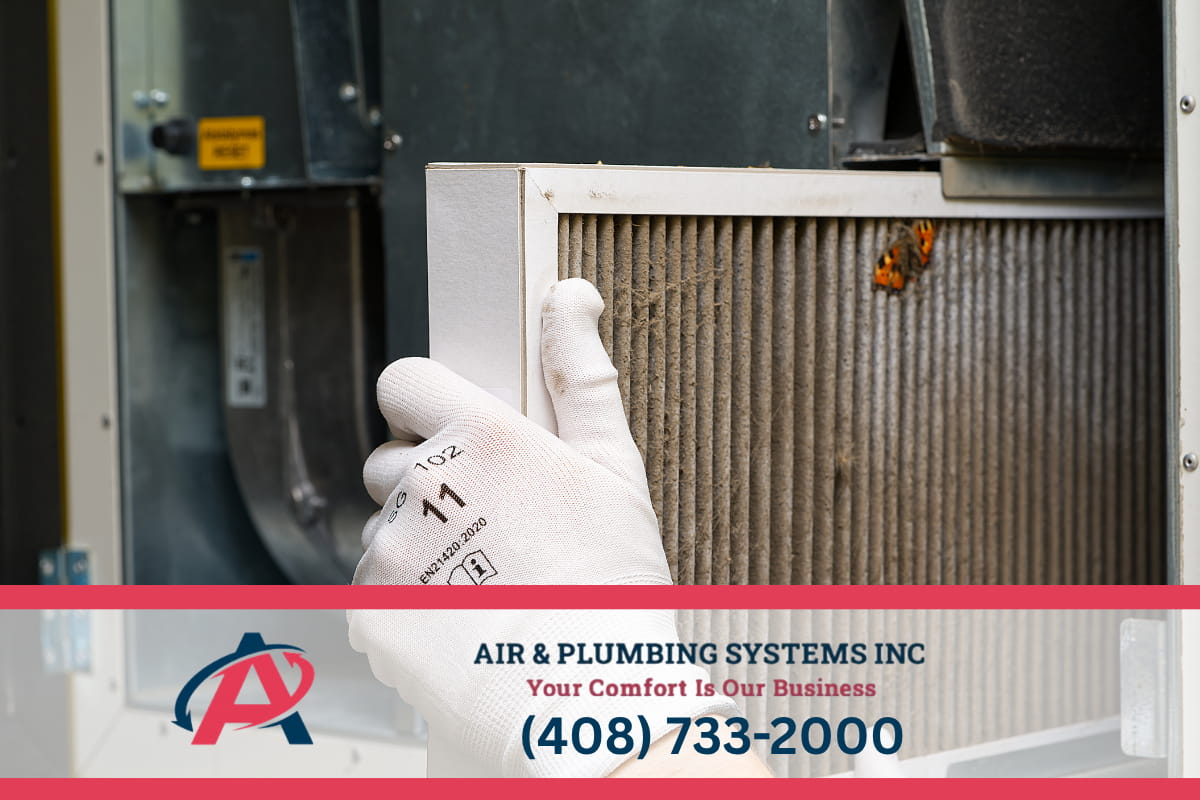
Quick answer: In order of effectiveness, the best indoor air quality (IAQ) solutions for allergies in Bay Area homes are:
- Upgrade the HVAC filter to MERV 11-13,
- Install a whole-home HEPA bypass or media air cleaner in the duct system,
- Seal duct leaks so unfiltered air from the attic and crawl space does not bypass the filter,
- Install a standalone HEPA purifier in the bedroom.
A real plan typically combines two or three of these—not just one.
The Bay Area’s allergy mix is especially complicated: oak and grass pollen in February-May, wildfire smoke in August-October, pet dander indoors all year, and homes that, due to mild weather, receive less natural ventilation than the rest of the country. That combination makes whole-home filtration more valuable here than almost anywhere else.
TL;DR
- MERV 11–13 filters can trap the particles that cause allergies. The inexpensive filter from the hardware store doesn’t.
- A whole-home HEPA bypass or media cleaner will be more effective than any portable air cleaner since it filters all the air that your HVAC system circulates.
- Leaky ducts in older Peninsula and South Bay homes can pull in unfiltered attic air, undoing 100% of your filter’s work.
- Use the fan, not only the cooling. In “ON” or “Circulate” mode, the air circulates through the filter even when the AC is not operating.
- Real relief in 5–14 days after proper system is in place—symptoms do not go away, but they do decrease.
Table of contents
- What “indoor air quality” actually means
- Why Bay Area homes have an allergy problem
- The five IAQ solutions that actually work
- Comparing your options—cost, coverage, effort
- Common misconceptions
- What it costs in the Bay Area
- FAQs
What “indoor air quality” actually means
Indoor air quality is simply a term for the pollen, dust mites, pet dander, mold spores, wildfire smoke particles (PM2.5), volatile organic compounds (VOCs) from cleaning products and furniture, and dust stirred up by everyday activities in the home. When any of these spike, your immune system notices.
Consider your HVAC system to be the lungs of your home. Every minute it runs, it pulls air from your living spaces, passes it through a filter, conditions it, and pushes it back out. If those lungs are wheezing, it’s an old filter, leaky ducts, undersized blower, and your whole home breathes worse.
If you have allergies, there are three numbers that are most important:
- MERV (Minimum Efficiency Reporting Value)—indicates the filter’s efficiency. The higher the number, the finer the particles that are trapped.
- HEPA—A more stringent standard: filters 99.97% of particles at 0.3 microns (the most difficult size to filter; smaller AND larger particles are easier to filter).
- AQI (Air Quality Index) — the outdoor metric, but it sneaks indoors quickly through windows, doors and (particularly) leaky ducts.
Why Bay Area homes have an allergy problem
The mild climate of California is a blessing and a bane. Most Bay Area homes were built without aggressive sealing—they don’t need to be airtight against -10°F winters, so they’re not. Add the unique mix of allergens in the area and you have indoor air that’s busier than it appears throughout the year.
- Coastal microclimate (San Mateo, Menlo Park, Palo Alto, Foster City): Marine layer and mold friendly humidity. Mold spores and dust mites flourish.
- Inland valley (San Jose, Santa Clara, Sunnyvale, Milpitas, Mountain View, Cupertino, Campbell, Fremont): Highest pollen levels, especially oak, juniper and grasses. Hot summers mean closed windows and more recirculation.
- Foothill communities (Los Gatos, Saratoga, Los Altos, Los Altos Hills): Dry summers and exposure to wildfire smoke. Plus additional outdoor dust that is brought in via attic vents.
- Estate / luxury homes (Atherton, Portola Valley, Hillsborough, Stanford): Larger square footage means more duct distance and more places ducts can leak.
The wildcard that the rest of the country doesn’t have: wildfire smoke. In 2020, PM2.5 concentrations exceeded EPA daily exposure limits for days on end in parts of the Bay Area, reaching levels of over 16× the EPA daily exposure limit. Smoke season is no longer a freak occurrence, but a planning consideration. A home that’s only filtering at MERV 6 during smoke days is, functionally, not filtering at all.
The five IAQ solutions that actually work
In order of impact-per-dollar for the Bay Area’s typical allergy stack:
1. Replace your HVAC filter to MERV 11 or MERV 13
This is the lowest cost, quickest win. Most builder-grade filters are MERV 6, which means they are designed to protect the equipment, not your lungs. A MERV 11 filter will remove most pet dander, mold spores and pollen. MERV 13 includes bacteria and smaller smoke particles.
Most blog posts don’t mention this, but not all HVAC systems are compatible with a MERV 13 filter. Higher MERV = more pressure drop = harder work for the blower. MERV 13 may restrict airflow to the point of affecting efficiency or triggering safety limits on older systems, particularly the variable-speed gas furnaces that are still found in many Saratoga and Los Gatos homes built in the early 2000s.
2. Install a whole-home HEPA bypass or media air cleaner
This is the upgrade that most allergy sufferers really require. A whole-home unit installs in your return duct or as a bypass off the main air handler, and it traps particles at near-HEPA performance without the airflow penalty of cramming a 4-inch HEPA filter into a 1-inch slot. The filter need to be changed every 6-12 months.
The price for a 2,000 sq ft home in San Jose or Mountain View is $1,200–$2,500 installed. The difference vs. a portable purifier is that this one filters every cubic foot your HVAC moves—not just the air within 12 feet of a plug-in box.
3. Seal duct leaks (the silent saboteur)
Older Peninsula and South Bay homes (pre-1990) have a typical duct system that leaks 20-30% of conditioned air into the attic or crawl space. Even worse, they draw unfiltered air from the attic back into the house through return-side leaks. The best filter in the world is not going to help if 1/3 of your air is going around it in holes in your ductwork.
The cost of duct sealing in the Bay Area is $1,000-$2,500, depending on access. It can provide greater relief to allergy sufferers than the filter upgrade itself. Most homes that receive a new HVAC system will also receive a duct sealing verification as part of the scope of work, as mandated by Title 24 (California’s building energy code).
4. Use a standalone HEPA purifier in the bedroom
You sleep there. You spend one-third of your life there. A true HEPA portable purifier in the bedroom—sized for the room’s square footage (look for CADR rating, Clean Air Delivery Rate, matching at least two-thirds of the room’s sq ft)—drops nighttime exposure dramatically. It is a common recommendation of all allergists for those who suffer from seasonal symptoms.
A quality air purifier typically costs $200–$500. Avoid products advertised as ionizers or ozone generators—the misconceptions section below explains why.
5. Maintain humidity and ventilation control
Dust mites thrive in humidity levels greater than 50% and so do mold spores. A whole home dehumidifier that is integrated with the HVAC system (approximately $1,800 to $3,000 installed) maintains the home in the 40-50% sweet spot.
The other side: during the winter, when houses are closed up, ventilation is as important as filtration. An ERV (Energy Recovery Ventilator) circulates filtered fresh outdoor air in while removing stale indoor air without adding to your heating bill.
Comparing your options—cost, coverage, effort
| Solution | Installed cost (Bay Area) | What it catches | Filter change cadence | Effort to install |
|---|---|---|---|---|
| MERV 11 filter upgrade | $20–$40 per filter | Pollen, dander, mold spores | Every 1–3 months | DIY, 5 minutes |
| MERV 13 filter upgrade | $30–$60 per filter | Above + fine smoke particles, bacteria | Every 1–3 months | DIY if system can handle it |
| Whole-home HEPA bypass | $1,200–$2,500 | 99.97% of 0.3-micron particles | Every 6–12 months | Pro install, half-day |
| Duct sealing | $1,000–$2,500 | Fixes airflow that bypasses your filter | One-time + verify every ~5 yrs | Pro install, full day |
| Standalone HEPA bedroom unit | $200–$500 | Bedroom air specifically | HEPA element every 12 months | DIY, plug in |
| Whole-home dehumidifier | $1,800–$3,000 | Dust mites, mold conditions | Annual service | Pro install |
| ERV ventilator | $1,500–$3,500 | Stale air, CO2 buildup | Pre-filter monthly | Pro install |
| UV-C light in air handler | $400–$900 | Mold and bacteria on coil (not pollen) | Lamp every 1–2 yrs | Pro install, 1 hr |
Expert tip: If you can only do two things, do a MERV 11 (or 13 if your system handles it) upgrade and a duct-tightness check. Together they cost under $200 in materials and routinely cut allergy symptoms in half within two weeks.
Common misconceptions
Myth #1: “An ionizer or ozone air purifier is more powerful than a HEPA filter”
Reality: Ozone generators don’t remove particles—they produce ozone, which is itself a lung irritant the EPA explicitly warns against in occupied homes. The California Air Resources Board maintains a list of certified air cleaners; anything that emits more than 0.050 ppm of ozone is banned for sale in California. Stick with mechanical (HEPA) filtration.
Myth #2: “My filter is okay, I replaced it a year ago”
Reality: A MERV 11 or 13 filter filled with a year’s worth of Bay Area pollen and dust is not filtering—it’s choking. Check monthly, change every 1-3 months as needed. See our furnace filter maintenance guide for the actual schedule.
Myth #3: “Ventilation can be improved by closing the vents in unused rooms”
Reality: When vents are closed, duct pressure increases, leaks get larger, and more unfiltered attic air is forced into your home. Leave them open. (We cover this and other cooling myths in this post on AC myths—same physics applies year-round.)
Myth #4: “A portable HEPA in the living room cleans the whole house”
Reality: The truth is that portable purifiers only filter the air near the purifier. They’re great in a single bedroom; they’re not a substitute for whole-home filtration in a 1,800 sq ft Mountain View ranch.
What it costs in the Bay Area
Real numbers for typical projects, by approach:
- Filter-only upgrade: $20-$60 per filter, replaced 4-12 times annually. Total annual cost: $80–$700.
- Duct sealing + filter upgrade: $1,000–$2,500 one-time. It pays for itself in 5-7 years based on HVAC efficiency alone, and allergy relief is the added benefit.
- Whole-home HEPA system install: $1,200–$2,500 installed for a typical 1,800–2,500 sq ft Bay Area home. Replace filters with $300-$500 every 6-12 months.
- Full IAQ package $3,500-5,500. This is the route for severe-allergy households or homes in the East Bay foothills near wildfire-prone areas.
Our HVAC ductwork cost guide for the Bay Area explains the line items of HVAC ductwork and where the costs are derived from. Plus, if your current system is already in dire need of replacement, an HVAC installation that includes IAQ upgrades is typically more affordable than purchasing them separately.
Sources
Get Cleaner Air Today
FAQs
Yes, with one caveat: only if your system can move enough air through it. A MERV 11 filter properly matched to your blower drops indoor pollen and dander by 60–80% versus a basic MERV 6. Most Bay Area homeowners report noticeable relief within 5–14 days of upgrading.
MERV 11 is the sweet spot for most homes — it catches the major allergens (pollen, dander, mold spores) without overloading the blower. MERV 13 adds fine smoke particles, which matters during wildfire season. If you live in Los Gatos, Saratoga, or anywhere prone to summer smoke and your HVAC can handle it, go to MERV 13. Otherwise MERV 11 is fine.
For a single bedroom, yes — and it’s a great first step. For a whole 2,000+ sq ft home, no. Portable purifiers max out at maybe 400 sq ft of effective coverage. Trying to do a whole house with three portable units costs more than a single whole-home installation and works worse.
Every 1–3 months. Check monthly. If you have pets or live in a high-pollen area like Cupertino or San Jose during oak pollen season (March–May), lean toward the 1-month end. We cover the full check-and-change rhythm in our furnace filter maintenance guide.
Yes — a properly installed whole-home HEPA bypass plus MERV 13 main filter catches the PM2.5 particles that make smoke days so brutal. Keep the system running on “fan on” or “circulate” mode during smoke events, even when the AC isn’t actively cooling, so air keeps moving through the filters.
UV-C lights kill mold and bacteria on the evaporator coil, which improves HVAC efficiency and reduces musty smells — but they don’t capture pollen or dander. They’re a useful add-on for households with mold sensitivity or in humid coastal areas, not a primary allergy solution.
Sometimes. If you’ve had a renovation, a pest issue, water damage, or visible mold in the ducts, yes. For a typical well-sealed system, duct sealing (closing the leaks) delivers more allergy benefit than duct cleaning (vacuuming the dust). Most reputable Bay Area HVAC contractors recommend sealing first, cleaning only if needed.
Yes — we provide indoor air quality assessments as part of our free in-home estimate across the Bay Area, including Cupertino, Sunnyvale, San Jose, Palo Alto, Mountain View, Los Altos, Saratoga, and surrounding cities. Bring your symptoms, we’ll bring the airflow meters.
Phone: (408) 733-2000
Email: info@airandplumbing.com
Ready to improve your home’s indoor air quality? Call (408) 733-2000 or fill out our online form to schedule your free, no-obligation in-home estimate. Air & Plumbing Systems, Inc. (CSLB #901246) will evaluate your filters, ductwork, humidity, and airflow, then recommend only the solutions that truly make a difference.
What Our Clients Are Saying