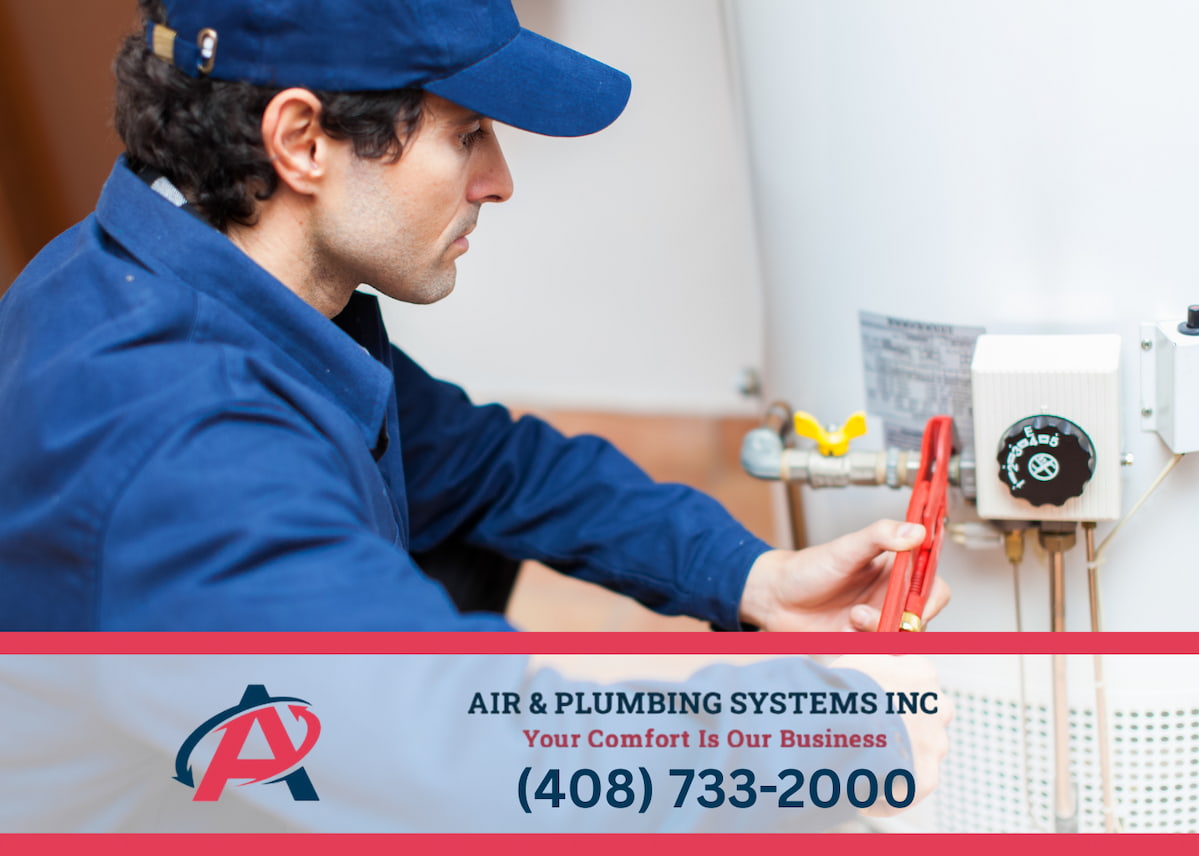
A water heater rarely fails without warning. It usually gives off signs first: rusty water, strange noises, a rising utility bill. Catching those signs early means a planned replacement on your schedule, instead of a cold shower and an emergency call.
Here are the seven signs to watch for, what causes each one, and what it costs to fix versus replace in the Bay Area.
Last updated: September 25, 2026 · Reviewed by the Air & Plumbing Systems team, licensed contractor (CSLB #901246)
Key Takeaways
- Most tank water heaters last 8-12 years. Past that age, a new symptom is usually a sign to plan a replacement rather than repair.
- Hard water in Santa Clara Valley speeds up sediment buildup, which is behind several of these signs (noise, reduced capacity, rising bills).
- If a repair costs more than 50% of a new unit’s price, or you’re calling for repairs annually, replacement is usually the better value.
- Under current BAAQMD Rule 9-6, new water heaters under 75,000 BTU/hr manufactured after January 1, 2027 must be zero-NOx. Proposed amendments (a Board vote is expected in late 2026) may push that date back a year and add exemptions, so it’s worth planning around either way.
Table of contents
- Your water heater is over 10 years old
- Rusty water or a rotten-egg smell
- Popping, rumbling, or banging noises
- Hot water runs out fast or temperature fluctuates
- Rising energy bills
- Water heater leaking from the bottom
- Frequent repairs (the 50% rule)
- What to replace it with
- FAQs
1. Your water heater is over 10 years old
A traditional tank water heater lasts 8-12 years on average. Past year 10, internal wear compounds: the anode rod that protects the tank from corrosion has usually eroded away, and sediment has built up at the bottom, making the system work harder for the same result.
Check the manufacturer’s sticker for the install or manufacture date, usually encoded in the serial number. If you can’t find it and you’ve owned the home more than 10 years, treat replacement as something to plan for rather than wait on.
2. Rusty water or a rotten-egg smell
Hot water that comes out rusty, muddy, or discolored usually means the inside of the tank is corroding. First, run the cold tap for a minute. If it’s also discolored, the issue is likely your pipes or the city supply, not the water heater. If only the hot water is affected, the tank itself is the problem, and once that corrosion starts, it typically progresses toward full failure rather than stabilizing.
A rotten-egg smell in hot water only (not cold) is a related but separate sign: it’s usually a reaction between the magnesium anode rod and sulfate-reducing bacteria in the tank. It’s unpleasant but not typically dangerous, and swapping the magnesium anode for an aluminum-zinc or powered anode often resolves it in an otherwise healthy tank. In an older unit already showing other signs, it points toward replacement instead.
3. Popping, rumbling, or banging noises
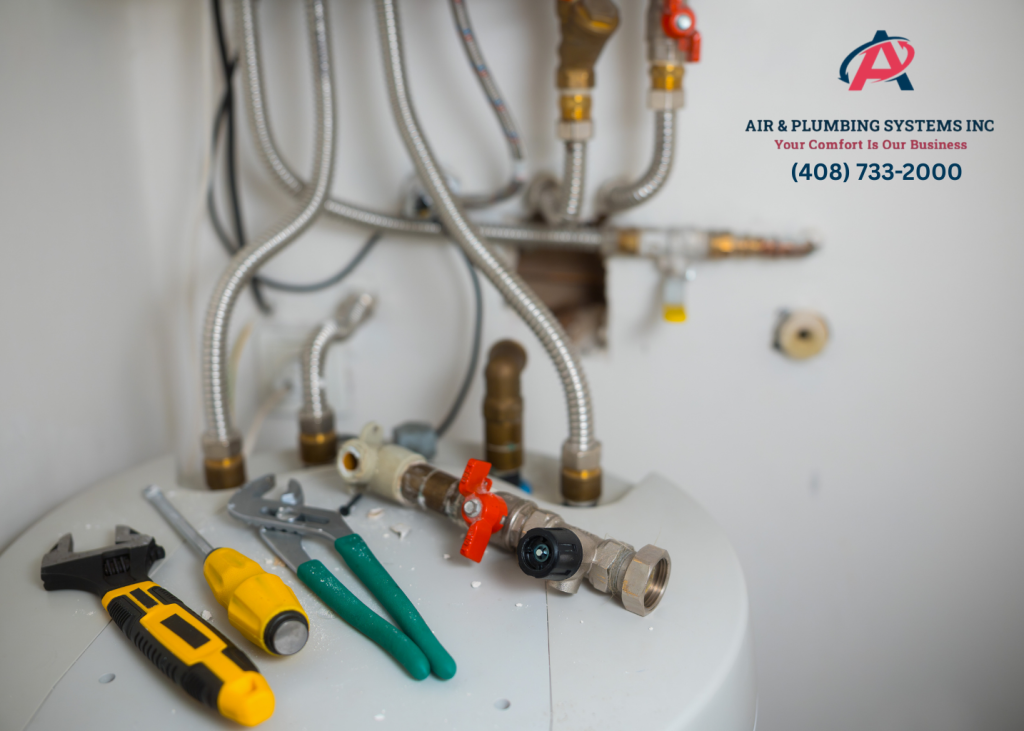
A popping or rumbling sound when the burner or element kicks on almost always means sediment has built up at the bottom of the tank. Water trapped under that layer turns to steam and bursts through it, a bit like popcorn cooking under a layer of sand.
Sediment forms faster with hard water, common across the South Bay and Santa Clara Valley. Flushing the tank once a year can slow the buildup. But once a tank over 8-10 years old is already loud, the sediment layer has usually hardened, and the bottom of the tank has been under repeated heat stress for a while. At that point, flushing rarely resolves the noise, and replacement is the more reliable fix.
4. Hot water runs out fast or temperature fluctuates
A shower that swings between scalding and lukewarm in the same session, or a tank that no longer holds enough hot water for a full shower, points to a failing heating element (electric) or burner (gas), or sediment interfering with heat transfer. Before assuming the worst, check two easy things yourself: confirm the thermostat setting hasn’t drifted, and on electric models, check whether the high-temperature limit switch has tripped. Turn off power to the unit at the breaker first, then remove the upper access panel and look for a small red reset button. If resetting it doesn’t hold, or the problem is gas-side, it’s time for a technician to look at the element or burner directly. A water heater that can’t hold a stable temperature is no longer doing the one thing it’s there for.
5. Rising energy bills
An aging water heater loses efficiency as sediment builds up and insulation degrades, so it takes longer and more energy to heat the same amount of water. If your gas or electric bill has climbed noticeably without a change in household usage or PG&E (or SVP, for Santa Clara) rates, and your water heater is past the 8-10 year mark, it’s a reasonable suspect.
A new high-efficiency unit, including a heat pump water heater (more on that below), often pays back part of its cost through lower monthly energy use, on top of whatever rebate applies in your city.
Not Sure If It’s Time? Get a Free Assessment
6. Water heater leaking from the bottom
Water where it shouldn’t be, especially around the base of the tank, is one of the more urgent signs on this list. Most leaks trace back to internal tank cracks or fitting failures caused by repeated thermal expansion and contraction, and they often start small: a little dampness at the base, or a puddle that appears and disappears.
Industry data from the Insurance Institute for Business & Home Safety, via Alpine Intel’s claims analysis, puts the average water heater failure claim at $4,444, with roughly 69% of failures caused by a slow leak or sudden burst. That’s the cost of the water damage itself, on top of the water heater replacement. A planned replacement is a fraction of that.
7. Frequent repairs (the 50% rule)
Every repair on an aging unit fixes one specific problem, but the underlying wear keeps progressing underneath it. If you’re calling for a repair at least once a year, or a single repair would cost more than half the price of a new unit, replacement is usually the better financial call.
A quick example: if a full replacement runs around $1,800 installed and a repair quote comes in at $950, that repair is over 50% of replacement cost on a unit that’s already old enough to need it, which is exactly the scenario the rule is meant to catch. A new unit also comes with a fresh warranty and better efficiency than the one you’re patching.
What to replace it with
If you’re in the Bay Area, there’s a regulatory reason to plan ahead rather than wait for a failure. Under BAAQMD Rule 9-6, new residential water heaters under 75,000 BTU/hr manufactured after January 1, 2027 must meet a zero-NOx standard, which rules out a standard gas replacement and in practice means an electric model, most commonly a heat pump water heater. Existing gas units aren’t affected and can keep running or be repaired.
In July 2026, the Air District proposed amendments that would delay that compliance date by one year (to January 2028) and add exemptions for low-income households and homes where electrical panel or space constraints make electrification difficult. A final Board vote is expected in late 2026. We’ll update this page once that’s decided, but either way, a heat pump water heater is worth comparing now, since it tends to be the most cost-effective zero-NOx option even before any rule forces the question.
Santa Clara homeowners can check our SVP heat pump water heater rebate guide for what’s active there, and homeowners elsewhere in the Bay Area can check our current rebate guide for what applies by city. If you’re deciding between tank and tankless as part of this decision, our tankless vs. tank comparison covers that question directly.
For over 25 years, Air & Plumbing Systems (CSLB #901246) has replaced water heaters across Campbell, San Jose, and the wider Santa Clara Valley, where hard water speeds up exactly the sediment and corrosion issues covered above. Our water heater installation team can assess your current unit and walk you through tank, tankless, and heat pump options during a free estimate.
FAQs
Traditional tank water heaters typically last 8-12 years, while tankless units can last 15-20 years with proper maintenance. Water quality, usage, and maintenance frequency all affect the actual lifespan. Hard water, common in the South Bay, tends to shorten it.
It’s not recommended. Installation involves plumbing, electrical, or gas connections, and California requires seismic strapping and a permit for water heater replacement. DIY installation can void the manufacturer’s warranty, skip required inspections, and create real safety hazards.
It depends on the problem. A minor fix, like a faulty thermostat, is usually worth repairing at 7 years. A cracked tank or multiple failing components points toward replacement even at that age, since the unit is already more than half through its expected life.
As a general guide: 30-40 gallons for 1-2 people, 40-50 gallons for 2-3 people, 50-60 gallons for 3-4 people, and 60-80 gallons for 5 or more. A technician can size it more precisely based on your fixtures and simultaneous usage.
As a rough guide for the Bay Area: a standard tank replacement typically runs $1,800-$3,500 installed, a heat pump water heater $4,500-$7,000 (higher due to electrical work, often partly offset by rebates), and tankless $4,500-$9,000 depending on venting and gas line needs. These are planning ranges, not a quote. Our tankless vs. tank guide breaks this down further, and a free in-home estimate gets you an exact number for your home.
On the BAAQMD timeline specifically: most residential gas tankless units sit above the 75,000 BTU/hr threshold that triggers the 2027 (proposed 2028) compliance date, which would put them on the later, 2031 schedule for larger equipment instead. Model output varies, so confirm the exact BTU/hr rating of any specific tankless unit with your technician before assuming which deadline applies.
No. BAAQMD’s zero-NOx rule applies to new water heaters manufactured after the compliance date, not to existing units. A working gas water heater already installed can keep running and being repaired. The compliance date itself may shift to 2028 under amendments currently under review.
Phone: (408) 733-2000 | Email: info@airandplumbing.com
Seeing two or more of these signs? Air & Plumbing Systems offers a free, no-obligation in-home assessment covering tank, tankless, and heat pump options. Call (408) 733-2000 or book online in just a few clicks.
What Our Clients Are Saying